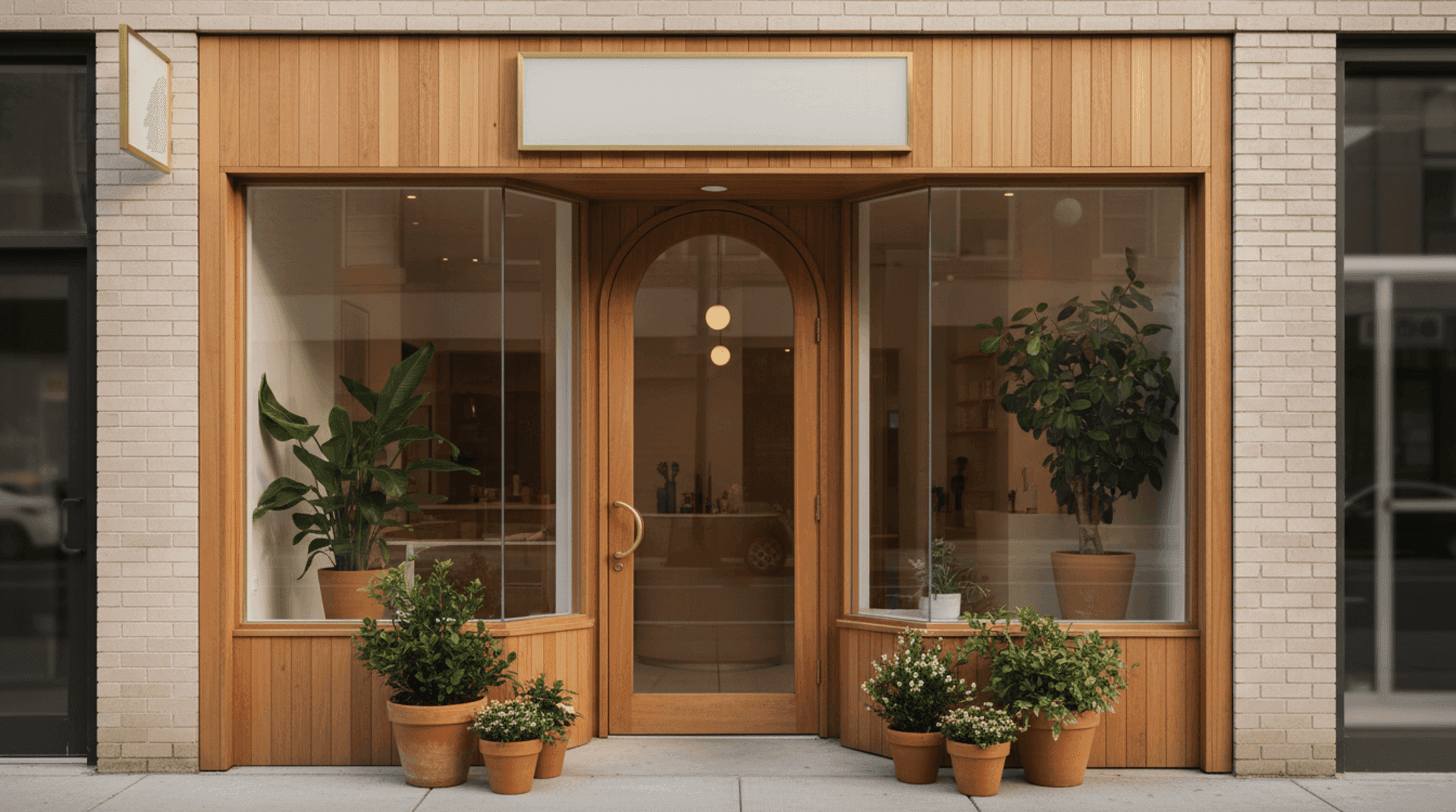
The Storefront You Already Own (and Probably Ignore)
Someone in your city wakes up at 11pm, can't sleep, and opens their phone. They've been thinking about it for months — the consultation, the treatment, the change. They type four words into Google: "aesthetic clinic near me." They are, in this exact moment, the most ready-to-book client you will ever meet. And the question is brutally simple: do they find you, or do they find the clinic three streets over?
Here's what stings. The thing that decides this isn't your beautiful website. It isn't your Instagram grid. It's a free profile most clinics set up once, badly, years ago, and never touched again — your Google Business Profile (in Polish: Google Moja Firma).
It's the digital storefront you already own. And like a real storefront with the lights off and the sign half-fallen, an ignored profile quietly turns people away — without you ever knowing it happened.
Think of It as Your Window Display
Picture your clinic on a real street. The window display is the first thing a passer-by sees. Clean glass, warm light, a glimpse of the calm inside — and they pause, and they consider walking in. Grime on the window, an outdated poster, no opening hours posted — and they keep walking, never once aware they made a decision.
Your Google Business Profile is that window. It's what appears when someone searches your clinic by name, and — more importantly — what surfaces on Google Maps and in the "local pack" (those three highlighted businesses with the little map) when someone searches for what you offer nearby.
Most people will judge your clinic from this window long before they ever reach your front door — or your homepage.
And here's the part that should make you sit up: this window does its work whether or not you've cleaned it. A neglected profile still shows up. It just shows up with the wrong hours, a pixelated photo from 2019, and a review you never replied to. The lights are on. They're just pointed at someone else.
Why This Tiny Free Thing Beats Almost Everything
Sit with that for a second. You can spend months perfecting a custom-coded website — and we build those, so I say this with love — but the very first decision, which clinics even get considered, often happens in a box your website doesn't control. The Business Profile is the gatekeeper to that box.
For clinics specifically, it does three jobs at once:
- It makes you discoverable to people searching by treatment, not just by name.
- It makes you credible, through reviews, photos, and the simple signal that you're active and present.
- It makes you bookable, with one tap to call, get directions, or visit your site — no friction, no second-guessing.
That's discovery, trust, and action — the entire client journey — compressed into a free tool you can fully control. Genuinely few things in marketing offer that ratio of effort to return.
The Setup Checklist Most Clinics Get Half-Right
Setting up a profile takes an afternoon. Setting it up properly is what separates the clinics that get found from the ones that merely exist on the map. Here's the order I'd work through it.
1. Claim and verify
If your clinic has ever existed, there's a decent chance Google already auto-generated a basic listing — and someone else could theoretically manage it. Go to Google Business Profile, search for your clinic, and claim it. Verification (usually by postcard, phone, or video) proves the place is really yours. Until you're verified, you can't edit a thing, so this is non-negotiable step one.
2. Get the core facts perfectly consistent
Your name, address, and phone number — what marketers call NAP — must match exactly what's on your website and anywhere else you appear online. "Studio Kowalska" in one place and "Studio Kowalska Sp. z o.o." in another reads as one business to you and two confusing fragments to Google. Pick one form. Use it everywhere.
3. Choose categories like a strategist, not a clerk
Your primary category is one of the strongest signals for what you rank for. Be specific: "Medical spa" or "Skin care clinic" rather than a vague "Clinic." Then add relevant secondary categories. This is also where honesty matters enormously — which we'll come back to.
4. Write the hours, the description, and the attributes
Set accurate hours, including holiday hours (nothing erodes trust like driving across town to a "closed" door on a day Google said you were open). Write a warm, human description — this is window-display copy, not a legal disclaimer. And fill in attributes: wheelchair access, parking, languages spoken. Small details, big reassurance.
5. Photos are not optional — they're the display itself
This is where clinics leave the most on the table. Upload real, high-quality photos: the reception, the treatment rooms, the team, the calm. People are about to trust you with their face, their skin, their body — they want to see the room before they sit in the chair. Stock photos read as evasion. Real ones read as confidence. (This is the same threshold psychology we explored in what your client decides in the first three seconds — the space is making promises before a word is read.)
6. Turn on messaging and booking — then actually respond
If you'll watch the inbox, enable messaging. If you use a booking system that integrates, connect it. A profile that lets someone act in the moment of intent converts far better than one that makes them go hunting for a contact form.
Reviews: The Part You Can't Fake (and Shouldn't Try)
If the profile is your window, reviews are the conversations happening on the pavement outside — strangers telling other strangers whether you're worth it. And for clinics, this is the single most powerful asset you have, because no amount of polish persuades like another human's relief.
Two principles, and only two, really matter.
Make asking a habit, not an event. The best moment to ask for a review is right after a client lights up about their result — at the end of an appointment, while the feeling is fresh. A gentle, specific ask ("If you've got a moment, a few words on Google would mean the world to a small clinic like ours") converts far better than a generic automated blast weeks later. Never buy reviews, never incentivise them, never write them yourself. Fake reviews are against Google's policies, increasingly easy to spot, and — for a clinic built on trust — a catastrophic bet against your own integrity.
Reply to every review. Yes, every one. A warm, brief reply to a glowing review shows you're present and grateful. A calm, non-defensive reply to a critical one shows you're professional under pressure — and future readers notice that more than the complaint itself. Just mind the privacy line: never confirm a person was a patient or reference their treatment in a public reply. Acknowledge, take it offline, stay gracious.
A Word of Caution for Medical and Aesthetic Clinics
Because so many of the brands we work with sit in aesthetic medicine, this part is too important to soften.
A Google Business Profile is a public, advertising-adjacent surface — and medical advertising is regulated in Poland and across the EU. Your categories, your description, the photos you post, and especially how you respond to reviews all carry professional and legal weight. Don't make claims you can't stand behind. Don't post before-and-after content without understanding the rules and consents that apply to it. Don't discuss a specific patient's care in public, ever.
This isn't a reason to avoid the tool. It's a reason to treat it like the serious front door it is — which, honestly, is exactly the standard your clients hope you hold yourself to.
The Profile and the Website Are Partners, Not Rivals
It's tempting to think the Business Profile makes a great website redundant. It does the opposite. The profile is the window; the website is the room you walk into. The window's whole job is to earn the step over the threshold — and then everything depends on whether the room delivers on the promise.
A flawless profile that links to a slow, generic, template website creates a jarring disappointment: the display was beautiful, the inside is a let-down. A flawless profile that opens onto a site that feels like you — calm, considered, unmistakably yours — completes a story the client started on Google. (Our Lumière aesthetic-medicine concept was designed for exactly that arrival.)
They work as a pair. Neglect either and you lose people in the gap between them.
- Claim and verify first — you control nothing until you do, and Google may have already made a listing in your name.
- Be exactly consistent with your name, address, phone, and categories everywhere online.
- Lead with real photos of your actual space and team — this is the window display, and people want to see the room.
- Make review-asking a gentle habit, reply to every review, and never fake or buy them.
- Mind the medical rules — categories, claims, imagery, and replies all carry legal weight for licensed clinics.
The quiet truth is that the clinic three streets over probably hasn't done any of this either. The local pack isn't won by the biggest budget. It's won by the practice that treats its free storefront with the same intention it brings to a treatment room. That can be you, this week, in an afternoon.
At Orpheus Studio, we build the room people walk into after the window earns the step — custom-coded clinic websites that finish the story Google starts. If your profile is finally pulling people in, let's make sure what they find feels like you.